
1 · Epoxy Flooring
Epoxy Flooring and Epoxy Mortar for Industrial and Commercial Areas
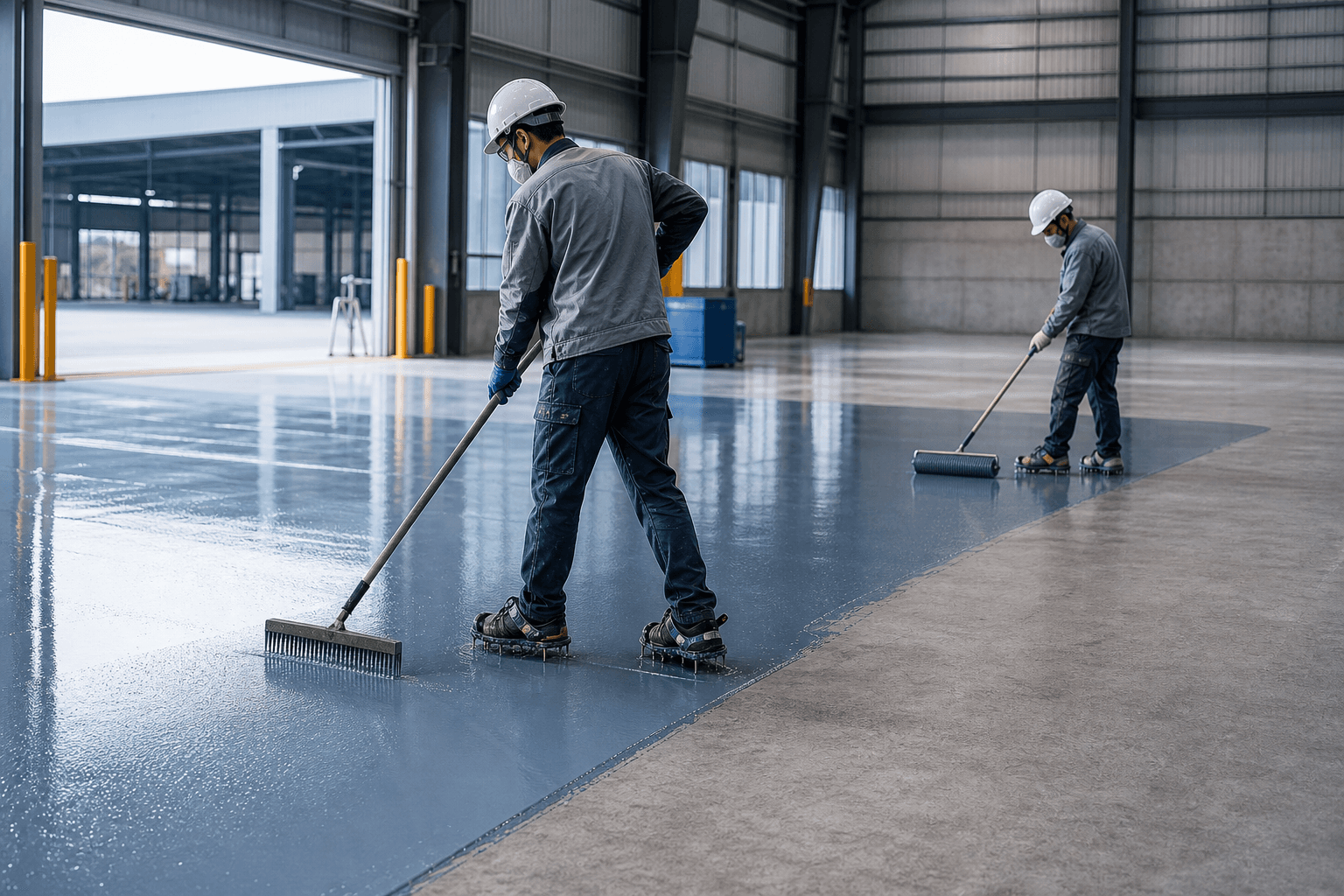
Resin flooring systems designed to create a seamless, cleanable, well-finished surface aligned with loading, impact, abrasion, and operational exposure.
2
When Epoxy Flooring is relevant
It may be considered for dusty or worn floors, cleanliness needs, static control, marking, and a finish suited to the area function.
- Concrete surfaces are dusty, worn, or difficult to clean
- The area requires a seamless surface with a neat finish
- The facility function has defined static-control requirements
- Coving, marking, or joint details form part of the required scope
3
More than a colored coating
System selection considers concrete strength and age, moisture, contamination, cracks, flatness, loads, abrasion, chemicals, temperature, and shutdown time.
4
System options
Epoxy Coating, Self-Leveling Epoxy, Anti-Static / ESD Epoxy, and Epoxy Mortar are selected according to area function, loading, and technical requirements.
- 1
Epoxy Coating
What it is
A protective resin layer for a prepared concrete substrate.
When it may be relevant
It may be considered for suitable light-to-medium operational requirements according to system design.
Condition to confirm
Concrete condition, exposure, and system build-up must be confirmed.
- 2
Self-Leveling Epoxy
What it is
A smoother seamless system for a suitable area.
When it may be relevant
It may be considered where cleanliness and finish expectations are higher.
Condition to confirm
Flatness, moisture, cracks, and substrate readiness still require evaluation.
- 3
Anti-Static / ESD Epoxy
What it is
A system for defined static-control requirements.
When it may be relevant
It may be considered in facilities with technical static-control requirements.
Condition to confirm
Performance follows the agreed specification, configuration, and testing.
- 4
Epoxy Mortar
What it is
An aggregate-filled resin mortar for thicker build and heavy loading.
When it may be relevant
It may be considered for areas with high wheel loads, impact, or abrasion.
Condition to confirm
Thickness, aggregate profile, moisture, and substrate preparation require evaluation.
5
What must be evaluated
Review the substrate, moisture risk, oil or chemical contamination, cracks, traffic, air temperature and humidity, and work access.
This list provides input for professional evaluation; it is not a self-diagnosis tool.
- Concrete strength, age, and readiness
- Moisture or rising-damp risk
- Oil, chemical, or curing-compound contamination
- Cracks, holes, honeycombing, and flatness
- Wheel or forklift loads, impact, abrasion, and chemical exposure
- Shutdown window, temperature, and humidity
6
Typical benefits
An appropriate system can create a seamless, cleanable surface and support a neat finish according to the specification.
- A seamless and cleanable surface
- Configuration can be aligned with area function
- Supports a neat professional finish
- May improve wear or chemical resistance when correctly specified
- Can include coving or marking when they form part of the scope
7
Application environments
Factories, warehouses, workshops, laboratories, hospitals, commercial kitchens, utilities, parking areas, and commercial buildings can be discussed according to condition.
- Factories and production areas
- Warehouses and distribution facilities
- Workshops and utility areas
- Laboratories and hospitals
- Commercial kitchens and commercial buildings
- Parking areas according to condition and function
8
Execution sequence
Stages follow the actual condition, selected system, and agreed scope.
- 1
Survey and area boundaries
Confirm the condition, function, exposure, access, and shutdown window.
- 2
Surface Preparation and repair
Cleaning, mechanical preparation, and repair follow substrate requirements.
- 3
Primer and system layers
Materials are mixed and applied according to the system and agreed scope.
- 4
Top coat and curing
Finish and curing follow the material, area conditions, and manufacturer guidance.
- 5
Inspection and handover
Area readiness is confirmed and documentation is completed according to scope.
9
Quality Control
Checks are performed at relevant stages according to the system and agreed scope.
- Area condition and readiness before application
- Material identity and mixing according to the system
- Application stages and scope details
- Thickness or testing where relevant and agreed
- Curing conditions and confirmation of area readiness
- Before–process–after records and handover documentation
10
Return-to-service expectations
Thickness, resistance, curing, and return-to-service time depend on the material, system build-up, substrate condition, temperature, humidity, and manufacturer guidance. The area must not be used before it is confirmed ready.
11
Related solutions
Compare solution paths according to the condition and function of the area.
12
Prepare your consultation
Share the initial context so survey needs and system options can be discussed more clearly.
- Project location
- Floor area and operational function
- Concrete condition and visible issue
- Approximate area
- Photos or video of the condition
- Work access and shutdown window
- Target timing
- Wheel, forklift, impact, abrasion, chemical, temperature, and humidity exposure
This information is an initial guide. System recommendations follow evaluation of actual conditions and the agreed scope.